
Miranda Kuo Gallery, 2018 (Photo by Parker Calvert)
William Henry Felinski is a multidisciplinary Philadelphia-based American conceptual visual artist believing there should not be walls between systems and fields. He primarily works with sculpture, photography, digital fabrication technologies, and installation. His work is influenced by conceptualism, minimalism, sound art, materials science, appropriation, and deals with perceptions and the physicality of time, mythology, ideas of permanence, systems, and random outcomes. Experimenting with immersive, interactive, participatory new-media projects that pair found objects, electronics, and formal sculpture elements, Felinski's hybrid practice investigates art and form making as a laborer integrating advanced digital and hand-built methods of fabrication to question the porous boundaries and contemporary intersections of art, architecture, design, and technology.

Whitney Museum of American Art, 2016 (Photo by Mike Moyer)
William Henry Felinski is a Philadelphia-based artist, industrial designer, arts organizer, researcher, and entrepreneur. He was born in Philadelphia, Pennsylvania, on July 6th, with family roots that are Pennsylvania Dutch and Russian. He works from his home studio, what he calls the laboratory, a place where failure is expected, where he shares meals and collaborates with other artists and friends. When he’s not in the studio, he’s riding his bike, playing tennis, or rock climbing in Philadelphia’s Fairmount Park.
In 2008, he enrolled at Science Leadership Academy, a project-based learning high school, and graduated in 2012 as part of its third class. During school breaks, he followed his interest in engineering and business through summer programs in materials science at the Laboratory for Research on the Structure of Matter (LRSM) with the University of Pennsylvania and in entrepreneurship at The Wharton School. For his senior capstone, he designed and built a rainwater collection, purification, and storage device, drawing on problems he had documented while doing environmental sustainability work in the Dominican Republic in 2011.
He started at Goucher College in 2012, initially in the 3+2 Science and Engineering Program with Columbia University. After taking his first sculpture course, he switched his majors to Studio Art and Arts Administration. He played Division III varsity men’s tennis at Goucher for three years, and his final season ended with the team winning the 2016 Landmark Conference Men’s Tennis Championship. During academic breaks he took additional coursework in metal sculpture, arts administration, and computational architecture at the University of the Arts (UArts), during an intensive course abroad in Amsterdam, The Netherlands, and at the Southern California Institute of Architecture (SCI–Arc). He received his Bachelor of Arts in 2016, having completed independent advanced studies with professors Allyn Massey in sculpture and Laura Burns in photography.
In Fall 2017, he began an MDes in Product Design at the University of the Arts, supported by a Presidential Fellowship. He earned the degree in 2019 for his thesis, “Design for Biofabrication: Innovative Manufacturing for Product Design,” which centered on the invention and production of MyGrow™ Helmet, a compostable bicycle helmet made entirely from fungi. His research asks how manufacturing might move away from current methods toward processes rooted in biology, drawing on biomimicry and biotechnology. In 2020, MyGrow™ Design was accepted into the Pennovation Accelerator at the University of Pennsylvania’s Pennovation Center. The six-week program ran from June to mid-July 2020, through the COVID-19 pandemic, and ended with each company pitching to investors on Pitch Day.
Felinski has worked as a freelance fabricator, industrial designer, and independent curator, and remains open to remote work. He runs three small organizations based in Philadelphia: MyGrow™ Design, a biotechnology venture where he is Founder and Director of Design; Olio Projects, a curatorial organization he founded and directs that began as an artist-run project space and now stages art, architecture, and design in alternative sites; and William Henry Felinski Studio, his own practice. Earlier, he founded Will’s Lamps, a small consumer lighting company that was his first startup; he wound it down in late 2018 to focus on the studio. In 2021 and through 2022, he was brought onto product projects for Nike and Chipotle, working alongside the design consultancy Deloitte Digital. He served as a lead industrial designer on one and as a biofabrication R&D manager on the other.
For much of 2023, he worked on two independent documentaries by filmmaker Brice Goldberg. He also volunteered as a biodesign consultant, mentoring a team of Philadelphia high school students who set out to turn locally found invasive plant species into biomaterials; their project was presented at the Biodesign Challenge Summit, in partnership with Aflua Future, in New York City at MoMA and Parsons. That same year, one of his photographs was included in Dancing Foxes Press’s book Alex Da Corte: Chicken, published May 16, 2023. He is credited as the photographer for an image of Alex Da Corte lit by a yellow spotlight in the final seconds of a performance reinventing Allan Kaprow’s 1962 “happening,” held at the Gershman Y at the University of the Arts in Philadelphia. At the end of 2023, he worked on his first major feature film, Mr. Crocket (2024, streaming on Hulu), in the art department under production designer Michelle Olivia Patterson. He is credited as a shopper, and also worked as a scenic and a dresser.
Since 2024, Felinski has been bringing other organic materials and organisms into his biomaterial research. His aim is a healthier set of basic manufacturing materials, focused on lifestyle and performance products across sports and leisure, with less toxic output. He is currently working freelance, after spending more than a year and a half in 2024–25 working back-of-house and learning to make bagels in West Philadelphia. He continues to study painting and new sculpture mediums on his own.
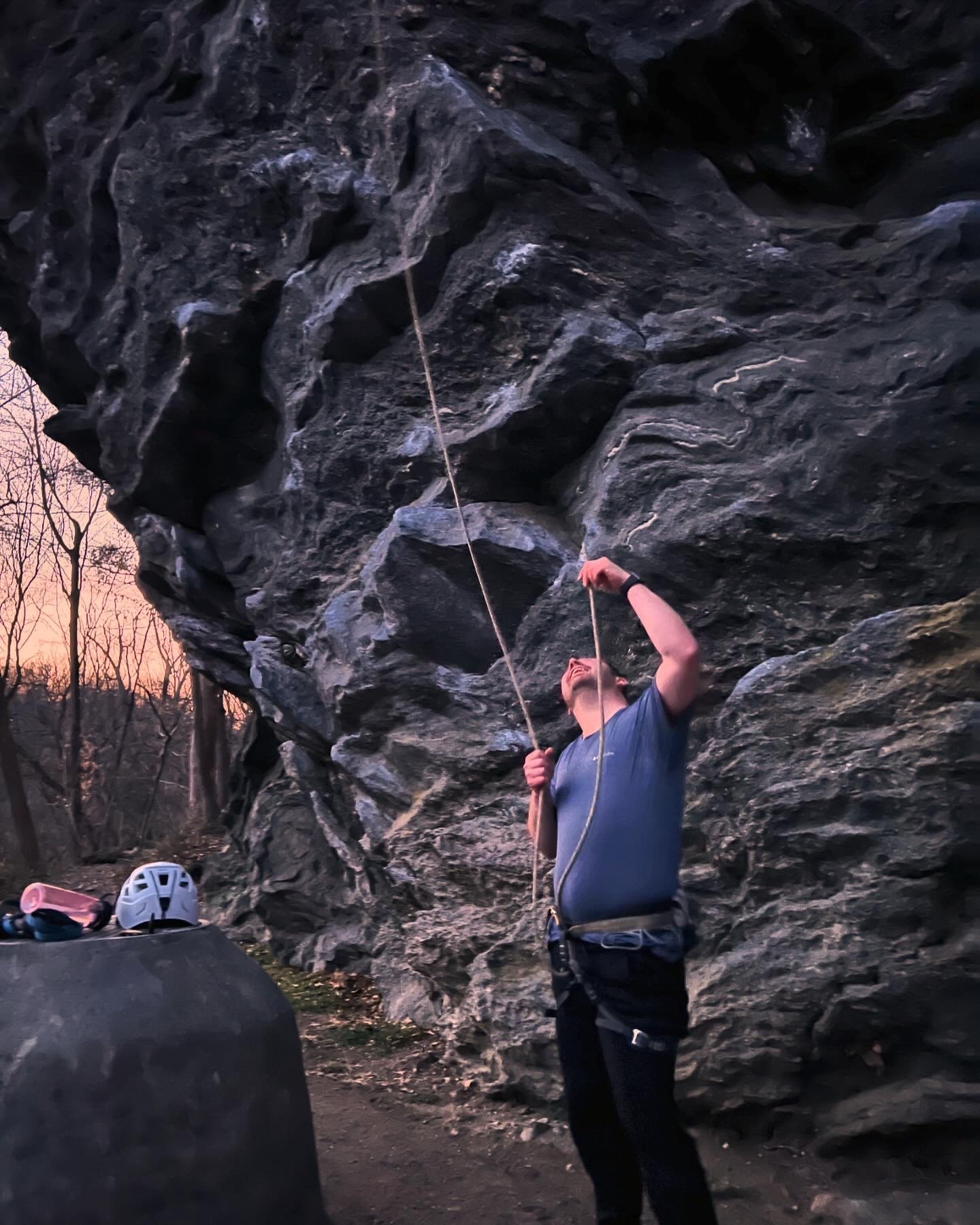
Fairmount Park, 2024 (Photo by Sebastian Zawierucha)